Published by Upholstery World Auckland · Reading time: 5 minutes
This is the question behind most of our initial enquiries: ‘Is my sofa actually worth reupholstering, or should I just get something new?’ It’s a genuinely important question — reupholstery is an investment, and it only makes sense when the piece is worth investing in. Here are seven ways to assess your sofa.
Check 1: Knock on the Frame
Sit on the floor beside your sofa and knock firmly on the frame with your knuckles. A solid hardwood frame sounds dense and resonant. Cheap particleboard or softwood sounds hollow or dull. A solid hardwood frame is the single strongest indicator that a sofa is worth reupholstering. It will outlast another 20–30 years of use once freshly covered.
Check 2: Sit Down Firmly and Stand Up
Do this several times. Does the frame flex or creak excessively? A small amount of movement is normal; significant creaking or flexing suggests the joints are loose or the frame is compromised. Loose joints can often be repaired before reupholstery — ask us when we assess it.
Check 3: Check the Springs
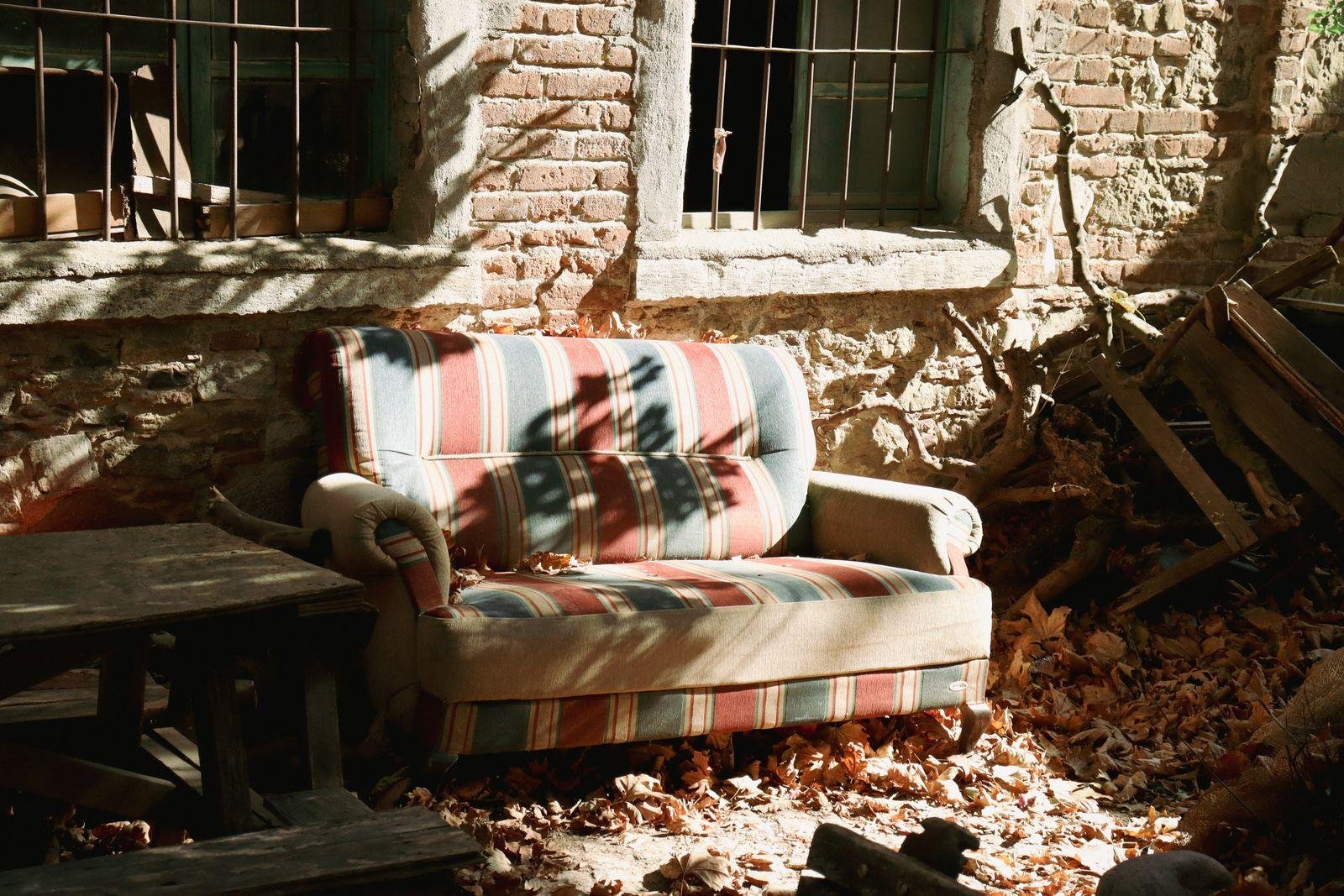
If your sofa has a spring system underneath, press down firmly on the seat. Can you feel distinct coil springs pushing back? Eight-way hand-tied coil springs are a hallmark of premium sofa construction and are found in quality furniture made before the 1990s. Sinuous (zigzag) springs are found in more modern sofas and are also perfectly serviceable. No spring system at all — just webbing or foam on a platform — suggests a lower-quality piece.
Check 4: Remove a Cushion and Inspect Underneath
Look at the quality of the base construction. Are there corner blocks at the frame joints? Is the webbing or spring system intact and evenly distributed? Corner blocks in particular are a sign of quality construction — cheap sofas often don’t have them.
Check 5: Assess the Foam Condition
Is the foam completely flat, or does it still have some life in it? For most reupholstery projects, foam replacement is recommended anyway to get the best result — but if the foam is completely degraded, that’s extra cost to factor into the equation.
Check 6: Check for Structural Damage
Look carefully for cracked or broken frame members, particularly at the arms and legs. Minor damage can be repaired before reupholstery; major structural failure may make the project uneconomical. Photos sent to us will allow us to assess this before you commit.
Check 7: Compare to Replacement Cost
The final test is financial. Research what it would cost to replace your sofa with a genuinely equivalent piece — same size, same quality of construction, same aesthetic. If that number is $2,500 or more, reupholstery is almost always the better investment. If you can buy a comparable new sofa for $800, the economics are less clear.
When the Answer is ‘Buy New’
There are situations where replacement genuinely makes more sense: the frame is structurally compromised beyond economic repair; the sofa is a cheap flatpack piece without a solid hardwood frame; or you simply want a different size or shape that your current sofa can’t provide.
Ready to bring your furniture back to life? Get a free quote from Upholstery World — Auckland’s trusted upholstery specialists.