Published by Upholstery World Auckland · Reading time: 6 minutes
A before and after reupholstery transformation is not just new fabric: the piece is stripped to the bare frame, repaired, given new support and padding, then recovered, so the “after” should sit, feel and wear like a new piece, not just look like one. This guide walks through what changes at each stage, what you should expect to see when your furniture comes back, and how to judge whether a before and after photo shows good work.
Before and after photos are the most common way people choose an upholsterer, and they are useful. But a photo only shows the outside. Most of what decides how long a reupholstered piece lasts happens underneath, at stages you never see. Knowing what those stages are helps you ask the right questions and compare quotes fairly.
What does “before” actually tell an upholsterer?
When you send photos for a quote, we are reading the “before” for clues about what is under the fabric, not just what is on top. The things we look for:
- The shape of the seat. A dip in the middle of a sofa seat usually means tired foam or broken springs, not just worn fabric.
- The arms and corners. Wobbly arms or gaps at the joints point to loose frame joints that need regluing before anything else.
- The fabric wear pattern. Wear concentrated on the front edge of a seat often means the padding has compressed and the frame edge is rubbing through.
- Trim and detail. Piping, buttoning, skirts and loose cushions all add workshop hours, so they shape the quote as much as the size of the piece.
Good “before” photos for a quote are simple: one of the whole piece from the front, one from the side, a close-up of any damage, and one of the underside if you can tip it safely. Daylight is better than a flash.
Not sure the piece is worth doing at all? Start with our seven checks to tell if an old sofa is worth reupholstering.
What happens at each stage of a reupholstery job?
Every piece is different, but a full reupholstery generally moves through the same stages. This is what changes at each one.
| Stage | What changes | Can you see it in the “after”? |
|---|---|---|
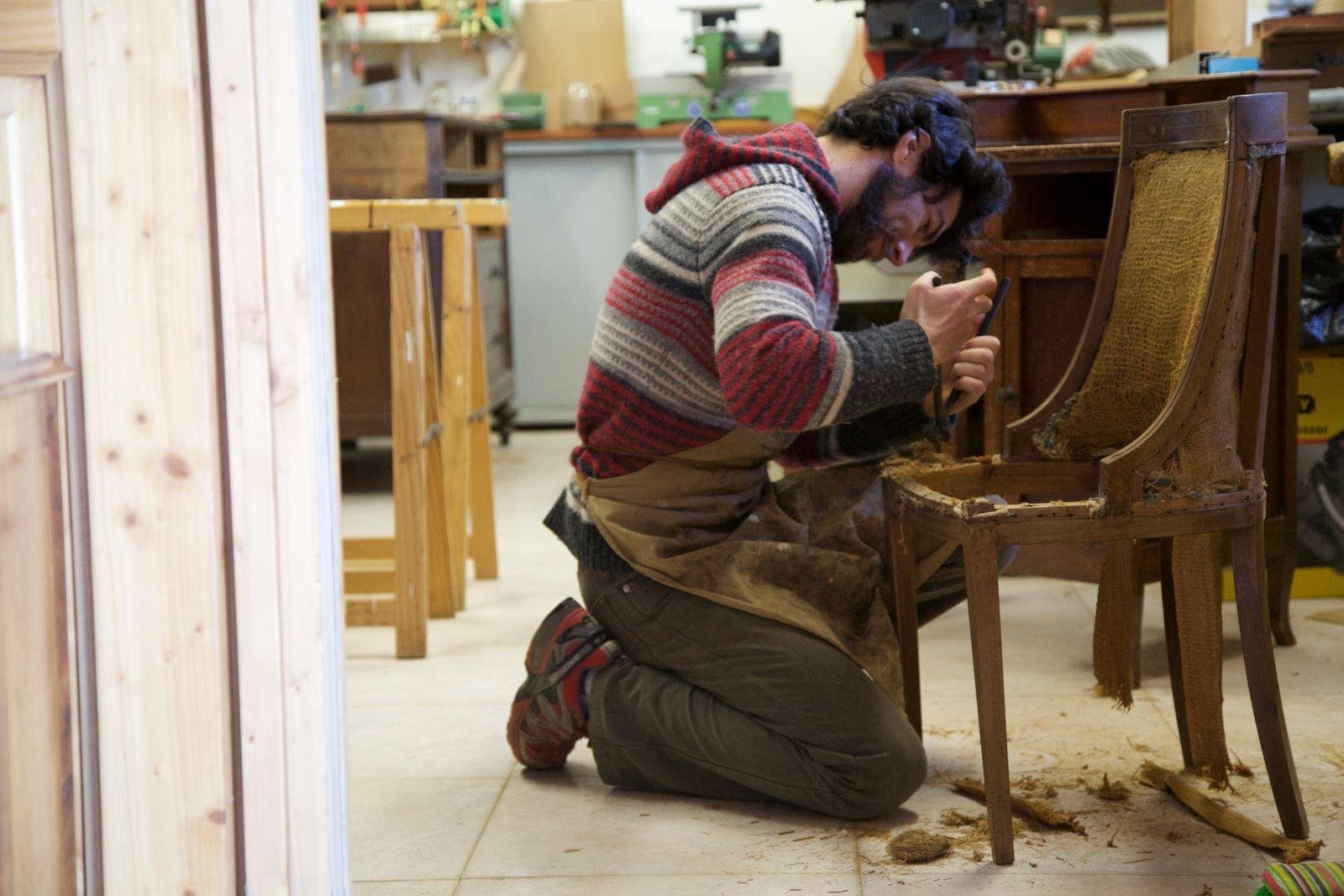
| 1. Strip back | Old fabric, staples, tacks and padding removed to expose the frame | No — but it is where hidden problems are found |
| 2. Frame repair | Loose joints reglued, cracked rails repaired or replaced | Indirectly — the piece feels solid, no creak or wobble |
| 3. Springs and webbing | Broken or shifted springs reset or replaced, new webbing fitted | Indirectly — the seat is level and supportive |
| 4. Foam and padding | New foam cut to shape, wrapped and layered | Yes — crisp edges, full cushions, no dips |
| 5. Cutting and sewing | New fabric cut, patterns matched, piping and cushion covers sewn | Yes — straight seams, aligned pattern |
| 6. Recover and finish | Fabric fitted and tensioned, trims, buttons and bottom cloth added | Yes — smooth, even tension and tidy underside |
Not every job needs every stage. A dining chair with a drop-in seat may only need new foam and fabric. A sofa with a sagging seat may need springs and webbing as well. That is why two pieces that look similar in the “before” photo can have quite different quotes.
Why can’t you judge a transformation from the outside alone?
New fabric stretched over old, flattened foam can look excellent on the day it is photographed. Within months the fabric starts to wrinkle and the seat dips again, because nothing underneath was fixed. The “after” photo looked the same either way.
So when you look at anyone’s before and after work, including ours, ask what was done underneath. A good upholsterer will tell you plainly whether the quote includes new foam, spring repairs or frame work, and why. Our sofa cost guide shows how those items add up on a typical three-seater: what sofa reupholstery costs in Auckland.
How do you judge a good “after”?
When your piece comes back, or when you are looking at photos of finished work, these are the signs of a careful job:
- Straight seams and piping. Piping should run in clean, unbroken lines along the edges, without waves or puckers.
- Matched patterns. Stripes, checks and large prints should line up across the seat, back and cushions, and be centred on each panel.
- Even tension. The fabric should be smooth and tight with no ripples, especially on the inside back and arms, without being so tight it distorts the shape.
- Crisp cushion edges. Foam should fill the cover fully, with square corners and no empty fabric at the edges.
- A level seat. Sit in each seat position. It should feel even, with no hollow in the middle and no springs you can feel through the padding.
- A tidy underside. Tip it over. A neat bottom cloth and evenly spaced staples are a sign the parts you cannot see were treated with the same care.
What should you expect to change, and what stays the same?
A reupholstered piece keeps its frame, its size and its shape. That is often the point: it already fits your room and you know it is comfortable. What changes is everything you touch.
- Comfort. With new foam the seat will feel firmer than you remember. New foam softens a little over the first few weeks of use.
- Look. Fabric choice has the biggest effect on the result. A plain linen-look weave, a velvet and a leather can make the same chair look like three different pieces. Our guide to choosing upholstery fabric covers what works for Auckland homes.
- Detail. You can change details as well as fabric: add or remove piping, change buttoning, swap a skirt for exposed legs, or add custom embroidery.
What does a reupholstery transformation cost?
Published Auckland prices, with fabric and labour included. All prices exclude GST.
| Piece | Typical Auckland cost (2026) |
|---|---|
| Dining chair | $80 – $300 each |
| Two-seater sofa | $600 – $1,200 |
| Three-seater sofa | $900 – $1,800 |
| Corner or modular suite | $1,500 – $3,000 |
Anything else, including armchairs, headboards and antique pieces, is quoted free from photos. For dining chairs specifically, see what reupholstering a dining chair costs in Auckland.
Frequently asked questions
How long does a reupholstery transformation take?
A sofa typically takes one to two weeks, including the time to order the fabric you choose. Smaller pieces are quicker. We confirm the timeline with your quote.
Will my furniture look exactly like new?
The upholstered parts will be new: fabric, padding and, where needed, springs and webbing. Exposed timber such as legs and arm facings is not upholstery and keeps its current finish, so if it needs attention, mention it when you send photos and we will tell you what is possible.
What if problems are found once the piece is stripped?
Stripping back is when hidden problems show up, such as a cracked rail or a broken spring. Good photos of the underside help us allow for these in the quote. Before you commit to any upholsterer, ask how they handle anything found once the piece is opened up.
Can I change the style, not just the fabric?
Often, yes. Piping, buttoning, skirts and cushion style can usually be changed. Major changes to the shape of the frame are a bigger job, so tell us what you have in mind when you send photos.
Get a quote on your own before and after
Send photos of the whole piece, a close-up of any damage, and the underside if you can. We will tell you honestly what it needs and whether it is worth doing. We pick up and deliver across Auckland, and we are open seven days: Monday to Friday 8am to 7pm, weekends 9am to 6pm.
WhatsApp +64 22 634 3792 or call 022 634 3792. Quotes from photos are free.
Read more about furniture reupholstery in Auckland, upholstery repairs across Auckland, the complete guide to reupholstery in Auckland, or leather vs fabric upholstery.
About the author. Viraj is the founder and lead upholsterer at Upholstery World Auckland, working across furniture, automotive, marine and commercial upholstery Auckland-wide. Send photos for a free quote on WhatsApp: +64 22 634 3792.